Russian emigré
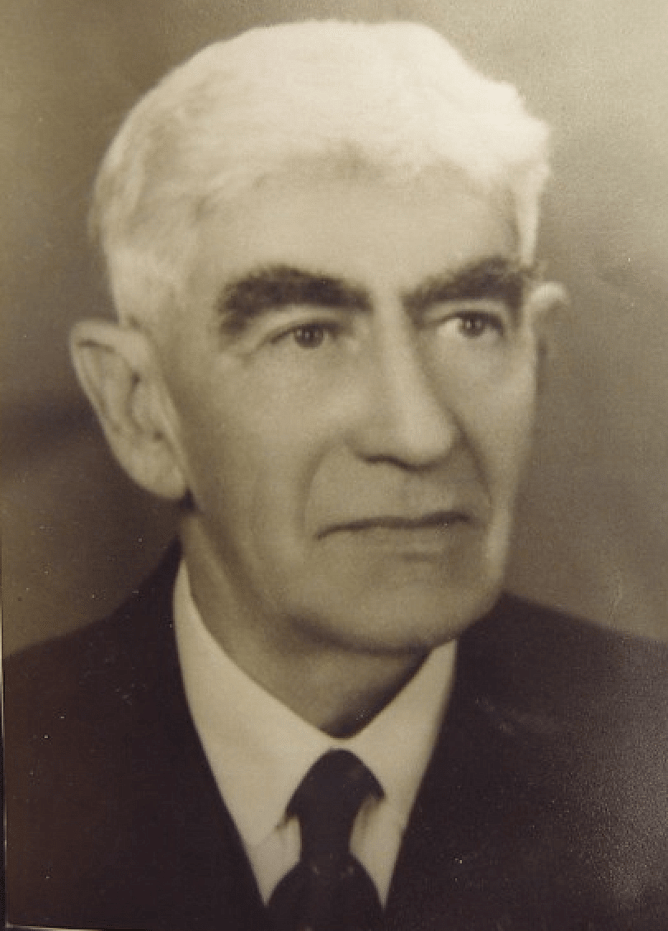
portrait of Ivan Black - MHS collection 0000.13.1
Ivan Black was not born Ivan Black. He came into the world around 1870 as Ivan Jacob Tchernegovski *, in what is now Kirovohrad — recorded on his death certificate as Elisavetgrad, then part of the Russian Empire, but now central Ukraine. By the time he died in New Zealand seventy-odd years later, he is said to have been a sailor on cattle boats between the Black Sea, England & the United States, was definitely an hairdresser, in which occupation he worked in both Ventnor, on the Isle of Wight, England and in Wellington New Zealand, a Whangarei farmer embroiled in a defamation suit, and a man who invested in early Matamata. Buying a quantity of sections, a farm, operating various businesses and involving himself in the community.
From Tchernegovski to Black:
As Tchernegovski he surfaced in the record as a Wellington hairdresser applying for naturalisation in October 1893
In 1894 he married Emily Gertrude Lees, and the couple went on to have five children — Wilfred, (who was born in England during a short return visit), Monica (Menica/Nica), Francis (who died in infancy in 1898), Cecil, and Eric — all registered under the Tchernegovski name. By November 1895, though, newspapers had begun referring to him simply as "Ivan Black," and the anglicised name stuck for the rest of his life. One son, Cecil, eventually made a switch formally changing his surname to Cherney in 1924.
The marriage to Emily did not last. Court reports from 1911 describe him charged with attempting to leave the country without making adequate provision for his four children, amid arguments over whether they should be raised Protestant or Catholic. Divorce papers say Emily deserted him around the same time; the divorce was finalised a full decade later, in 1921.
Land agent, farmer, defendant:
Through the 1900s and 1910s, Black held a number of trades. Probably all at the same time. He was working as a land agent, trying to sell a carrying business, a string of Newtown cottages, and "two of the best business sites" in Wellington and in 1908 was charged with organising a lottery in connection with the Wanganui Steeplechase. He was fined £10. All while still being a ‘tobacconist of Newtown’. By 1912 he was in Auckland styling himself "Ivan Black & Co, Land and Estate Agents", and running Wanted-ads for housemaids, cooks, a waitress and a porter as well as an upholsterer to do some work at a private house. Was this an early try at running a boarding house?
In 1916 he appeared in a list of guests at an hotel in Whangarei. Another guest was M.H. Hampson a solicitor from Rotorua who also had business and property interests in Matamata. Perhaps this was when he first heard of his future home.
The Whangarei visit must have been for a farm purchase. He was later accused of stealing his neighbour's cattle, a charge that was dismissed, but which escalated into a legal saga. Black turned around and sued that same neighbour, Alexander Gordon Mackenzie, for defamation, winning £384 in damages after a four-hour jury deliberation in the Supreme Court. Mackenzie appealed, and the ruling was overturned.
Matamata
By 1919 Black had moved on to Matamata, buying up properties there with Jessie Kenman, a boarding-house keeper he would go on to marry in 1922. In 1920, an application was made for a liquor license for an ambitious new establishment in Matamata. Ivan & Jessie were among those against it, and despite what sounds like the backing of "anyone who was anybody" in town, the licence was refused. By this time Ivan and Jessie were running the Grosvenor Hotel otherwise known as ‘Black’s Boarding House’, situated on the corner of Tui and Arawa Streets, conveniently opposite the railway station. An establishment with a liquor license would have been serious competition. Nevertheless he supported an application to the Minister in 1923 for the granting of liquor licenses in Matamata.
Ivan Black became one of Matamata's most persistent civic figures through the 1920s. He was elected to the Town Board repeatedly, sat on the Chamber of Commerce, pushed hard (via a stream of letters to the editor) for a municipal theatre, (for which he commissioned his own plans, the originals of which can be viewed at Te Whare Taonga O Waikato Museum and Gallery), sewage connections, and better footpaths. As well, he served as a director of the Hinuera Dairy Company. He built shops, ran the Grosvenor Hotel, and never seemed to be short of an opinion.
Matamata was not always kind to him. His car was stolen in 1926. A fire took out his Arawa Street shop the same year. And in September 1930, at the height of the Depression, the Grosvenor Hotel burned down entirely. He tried to sell his farm at Hinuera again that year but later told voters he was retiring to live on it rather than seek re-election to the Town Board.
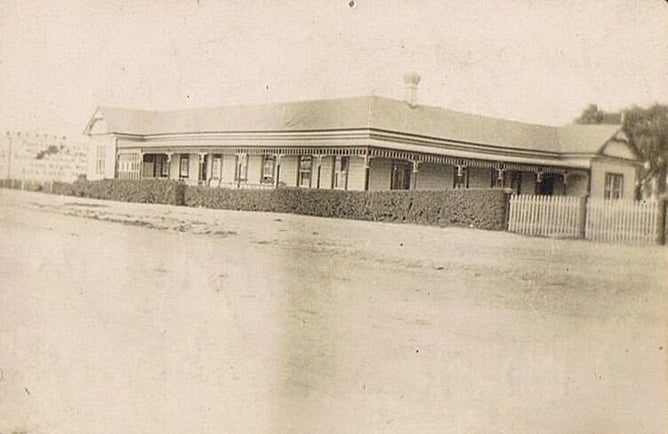
Black's Boarding House (the Grosvenor Hotel) MHS 0000.13.1. Corner of Tui and Hetana/Arawa Streets
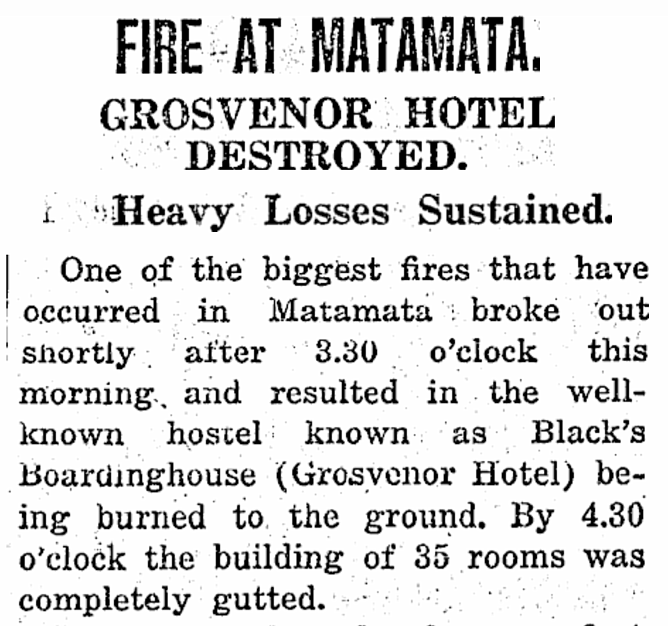
article continues at Matamata Record, 8 September 1930, page 5
Later Years
Black spent the 1930s running a garage and service station and, in one final return to his original trade, a hairdressing salon — advertising for staff as late as 1941, shortly before closing the business for good due to ill health. He auctioned off his plant and fittings that August and died in April 1942 He was cremated at Waikumete and his ashes scattered.
There is one last twist worth mentioning. His death certificate lists only the children from his first marriage to Emily, none from his second marriage to Jessie. That detail solves a small local mystery: a man named Robert Black, long assumed around town to be Ivan's son, appears instead to have been his grandson, the son of Ivan's daughter Monica and her husband Francis Edward Carson. (NZ BDM birth ref 1921/1849)
Sources
1891 census of England & Wales
Paperspast
NZ Archives
Matamata Historical Society
NZ register of Births Deaths & Marriages
* A note on FindaGrave gives his birth date as 28 Dec 1867 and his original name as Yakov Meyer Chernyakhovshy, that he was Jewish and that his family were killed in a Pogrom in 1881, after which he made his way to England.