Promoting the Town.
During the late 1920s and the 1930s the people of Matamata worked hard to establish the town and promote it. Forming in particular the Chamber of Commerce (although not until 1919) and Beautifying Society (first mooted in 1926 but not launched until 1929).
In 1937 “Come to Matamata Week” was held and reported to be highly successful. (the promotional booklet can be read here)
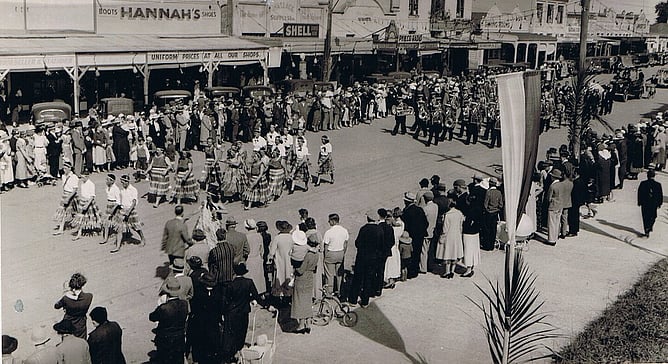
Parade, Arawa Street, "Come to Matamata Week", 1937. MHS collection
Then came World War 2. The Beautifying Society went into recess, and business groups in the town had other things to occupy them.
After the war, civic efforts went into such things as the rehabilitation of returned service men and sending food parcels to friends and family in England as well as trying to attend to deferred works suspended during the war. There were shortages of steel, parts and manpower and money, and when they could get manpower they couldn’t provide them with accommodation. Minds were greatly exercised with the problem of housing and the shocking conditions in which workers at the postoffice laboured - see Blog posts yet to be written. Then there were power cuts!
But minds were turning to the appearance of the town, with complaints about the state of the area behind Arawa Street and Broadway (now occupied by the access lane and Farmers Carpark). The fire brigade was also concerned about fire risk and it was decided to involve the health inspector.
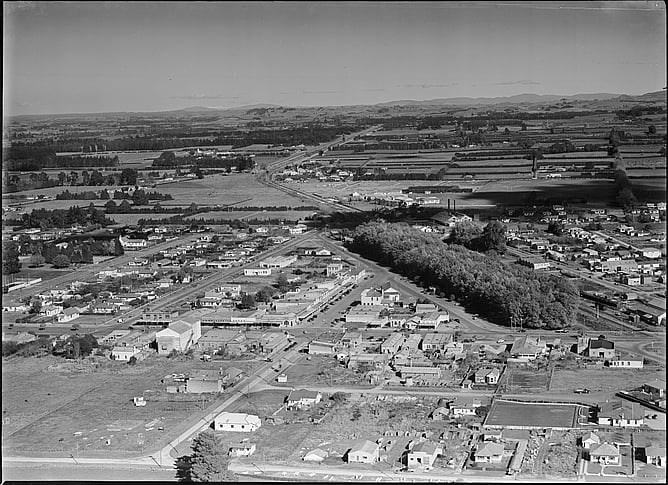
This aerial view of the town centre is dated 1951.
The Junior Chamber of Commerce, the Jaycees, embarked upon a programme of cleaning up unoccupied sections around the town. They levelled the 'triangle' between Arawa & Tainui Streets.
The Matamata Record of 16th June 1949 published a piece which began "The restoration of Matamata borough to that clean appearance for which it was noted prior to the war is gradually being brought about".
The work of the Jaycees continued and in August they presented the town with 185 hand made street signs. "a long and arduous job ... members had cut, dressed and bevelled the timber, had given the signs a priming coat, and two further coats of paint, stencilled on the names and then varnished them."
It is clear at the end of 1949 that at last people are beginning to feel some progress within the town. "the progress made by Matamata as a shopping centre during the last 18 months or so has been phenomenal..... Matamata does in reality now serve a population of 9000 residents throughout the district and that does not take into account the 70,000 who annually visit one of the Matamata hot springs. ....... nearly 50 buses arrived and departed from Matamata daily"
In 1950 the Minister-in-Charge of the Tourism Department embarked upon a New Zealand wide tour of tourist resorts. The Chamber of Commerce lost no time in sending a telegram! ( I note now they are now claiming 100,000 visitors to the springs annually, compared with 70,000 just a few months ago!)
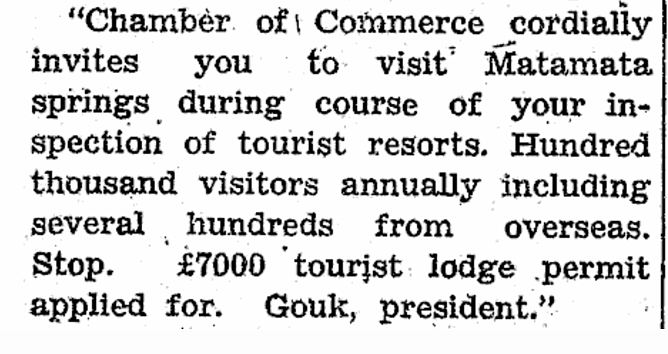
And in April, the Minister telegraphed he would come.

Matamata Record 13 April 1950.
I have been unable to find any evidence that he ever did turn up.
A Chamber of Commerce meeting in July 1950 turned it's attention to Centennial Drive. It was proposed the chamber 'consider what could be done to encourage the completion of the Town Belt beautification scheme' recording that ' in 1939 a plan was drawn up providing for a Centennial Drive lined with trees. It was intended to be a beauty spot. Many old or former residents assisted in planting trees which commemorated the pioneers of Matamata"
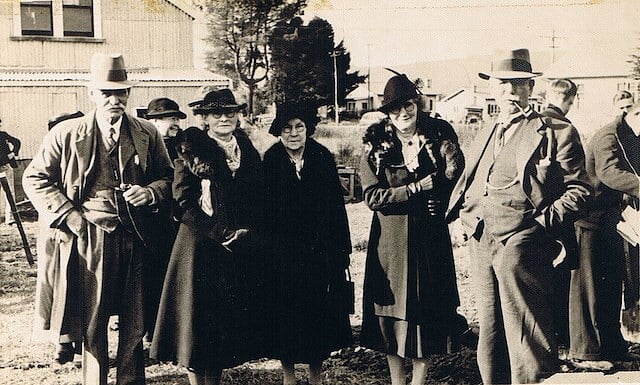
MHS Collection. Left to Right Mr J Simpson Mrs J Cranswick Mrs Green ( Mrs Ellerys Mother ) Mrs J Simpson Mr J Cranswick. On tree planting day 1939
But later in the year, considerations of cost, mainly because newly planted trees would need to be fenced to protect them from stock, and concern over who would do the upkeep, it was shelved again for the time being. Matamata Record 6 Nov 1950
A small group are doing their very best to improve the aesthetics of the town. In 1949 the Jaycees had inaugurated a garden competition and hoped another group (such as the Rose Society) would take over the organisation, however it fell to the Jaycees to run it again in 1950. But some 40 gardens were entered and a good number of people visited these gardens on judging day. Matamata Record 16 November 1950
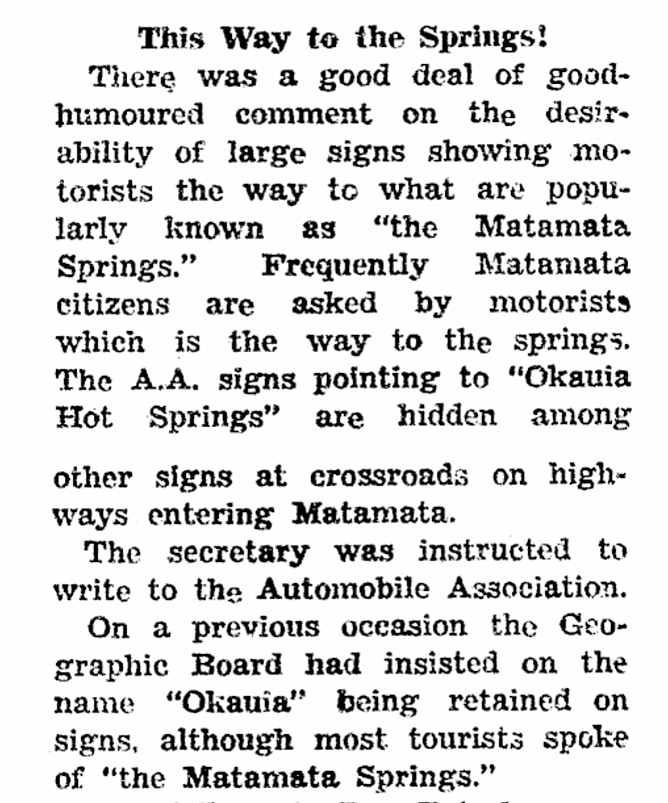
More and more the minds of the Chamber of Commerce were turning toward the source of revenue generated by visitors to the springs.
And the rear access to the shops in Arawa Streets and Broadway is again on the agenda of both the council and the chamber.
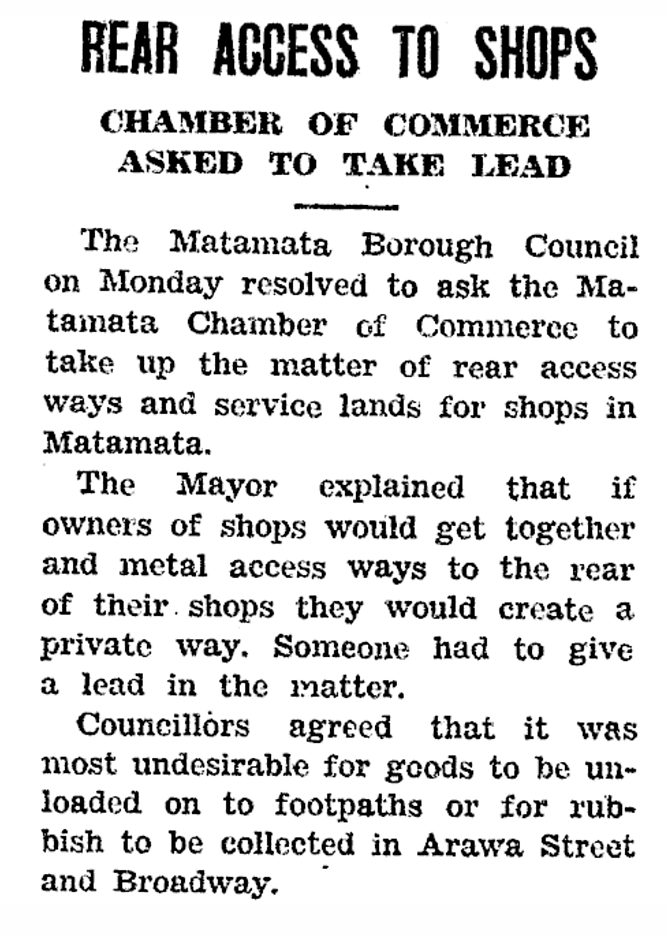
Matamata Record, 8 March 1951
At last, in 1953, the town's mind can turn to celebrating 50 years since the survey of the town in 1904. A week of carnival was planned for 1954 aiming to attract visitors from all over New Zealand. Mr C. G. Payze led the Golden Jubilee committee.
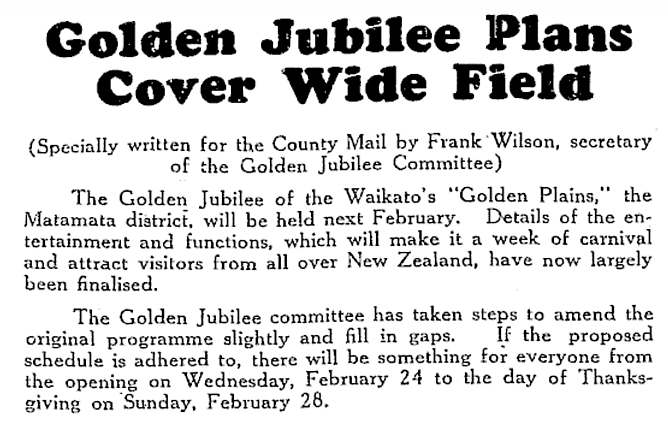
Article continues here. Matamata County Mail 7 October 1953
The festivitites were timed to coincide with show day, which was itself highly successsfu as reported in the Matamata Record on March1st.
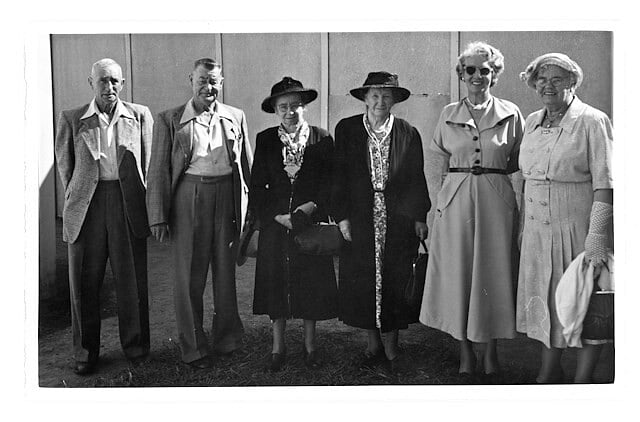
Early Residents of Matamata photographed in 1954
Joe Feisst, Ted Strong, Cissie O'Keefe, Mary Lovie Schwarz, Rose Feisst, Mrs Egan (from MHS collection)
Following the week of celebrations energies turned toward attracting visitors at Christmas time.
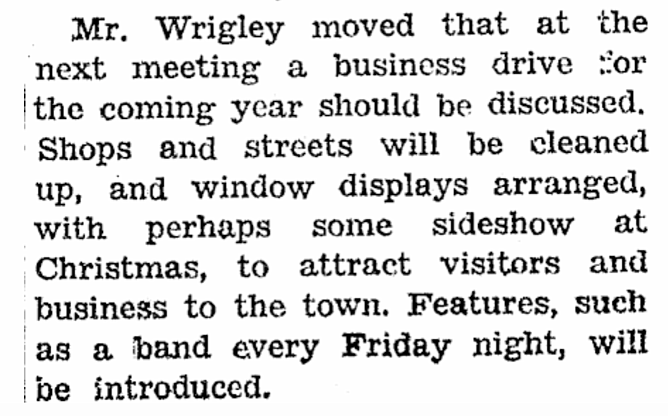
I can find very little discussion of this laudable plan through the year and then a meeting of the Chamber of Commerce on 7th December 1954 had to be abandoned because there was not a quorum.
The agenda, reported on the 8th December, under the heading "LACK OF INTEREST IN TOWN'S PROGRESS" included merger of the Chamber of Commerce & Matamata Businessmen's Association, Christmas Decorations and the perennial favourite - the post office!
It is ironic then, that after the holiday period, there were complaints there had not been enough done to promote the businesses in town to the visitors at the Springs over the holidays.
This seems to have been a final straw and Mr A. E. Wrigley the president of the Matamata Chamber of Commerce proposed that a public meeting be held for anyone interested to attend with the aim of forming a Public Relations Committee. This was held and reported on 15 June 1955
"It's job will be to boost Matamata and attract visitors to the town"
It should not be a charitable organisation
A permanent committee would be an asset to the town
An organising secretary should be employed.
Poor Mr Wrigley was elected chairman, although he felt it was a post for a younger man. Inevitably there were some who did not want to promote the town.
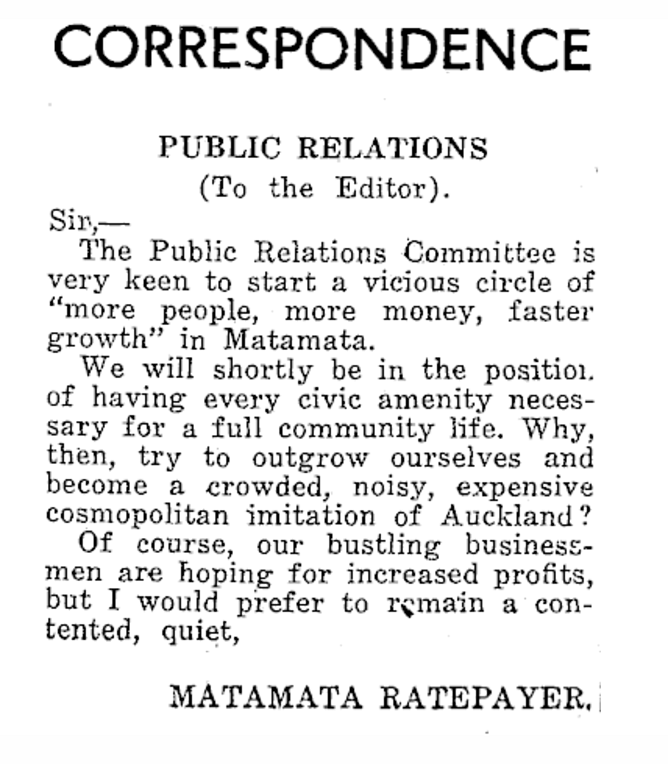
And so, the Public Relations Association (P.R.A.) was born. Mr A. D. Turner was appointed the organising secretary in October 1955 and his first task was to organise a Christmas Carnival.
Matamata County Mail, 22 June 1955