Green coaches, a demanding boss, and the people who kept the Waikato moving
For forty-one years, from 1928 to 1969, the dark green and white coaches of Edwards Motors were a familiar sight on the roads between Auckland, the Waikato and the Bay of Plenty. They carried passengers, parcels, mail bags, cinema films, cartons of beer and the morning Herald to towns like Te Aroha, Morrinsville, Matamata, Tauranga and Rotorua, at a time when most New Zealand households still didn't own a car.
In 2003 two former staff, Ann and Laurie Stokes, gathered the recollections of drivers, office staff, hostesses, mechanics and managers into a book, Edwards Motors 1928–1969: Staff Memories. They dedicated it to Andy Anderson, who brought the old team back together for their first reunion in 1977. What follows draws on that book: a company history told almost entirely by the people who worked there, and full of humour, hard work and the shadow of one formidable boss.
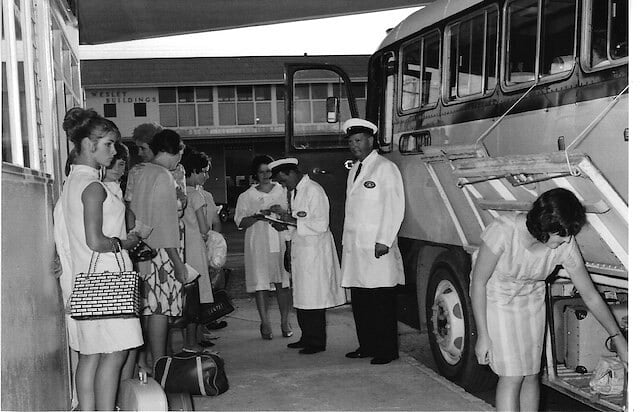
Men in white coats: left Laurie Stokes (also driving instructor in town) and Wally Harvey
From a Chandler on the back roads to a fleet of Vistaliners
Charles L. Edwards started his service in 1928, aged just 20. He had to run without a passenger driver's licence until he turned 21. With 19 operators already crowding the Auckland–Hamilton road, he chose the back roads to Te Aroha via Te Hoe, Tahuna and Morrinsville. At the 1985 reunion he remembered changing tyres under street lights, and awkward interviews with traffic inspectors who disliked passengers riding on the running boards and in the luggage trunk.
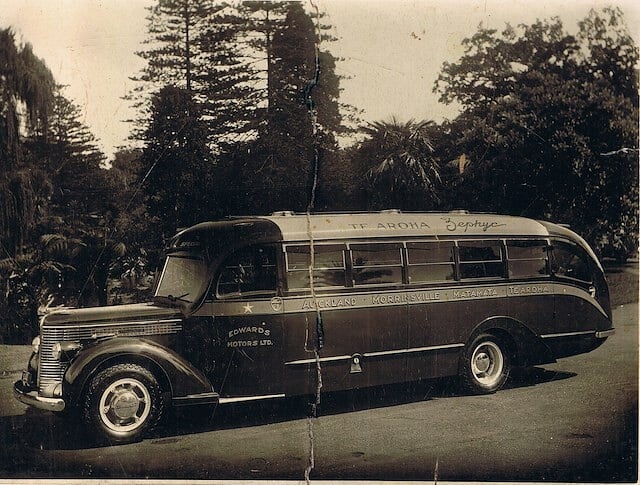
In 1931 he bought a Reo Parlour Coach in Palmerston North. Its dark and light green body, white roof and blue band was so smart that it became the Edwards livery. By 1938 the fleet lined up on the Auckland waterfront near the Parnell Baths included a Studebaker, a Pontiac, a Nash, two Reos, the Fargo No. 8 and a V-12 Cadillac. "I almost cried when we sold her," Charlie said of the Cadillac.
Keeping it running through the war
When war came, Charlie and his traffic manager Maurie Evershed joined the Air Force. Workshop supervisor Gordon Harrop and office manager Anona Montgomery ("Mrs Monty") ran the business. They managed with drivers the Army didn't want, short supplies of parts, tyres and fuel, and buses running on gas producers that Gordon built himself. Digger Tibby remembered driving No. 10 with a coal gas burner on the front bumper that saved almost half the petrol. Gordon later admitted his nerves "started to pack up" and he took a year off once Charlie returned.
Diamonds, Pushers and a web of licences
The Diamond T era began with No. 10, the "Zephyr", in 1938. New chassis were impossible to get, so some Diamond T coaches were built on rebuilt pre-war logging truck chassis. No. 17 was the drivers' favourite, "a real thoroughbred".
After the war Edwards expanded fast. Digger Tibby opened a Te Aroha branch in 1945, followed by services to Paeroa, Rotorua and Tauranga. In 1946 Charlie bought Stanley Motors of Matamata at midnight from "Big Bill" Stanley, who warned that Road Services were after him too. "I asked him whose money was the best, and he took ours!" That purchase brought the Kaimai route to Tauranga, which became the company's main trunk line.
In 1948 four huge packing cases arrived at the Parnell garage from America. Inside were the first rear-engined coaches in New Zealand. The Reo "Pushers" were quiet, soft-riding 37-seaters with names like Mainliner, Landliner, Cruiseliner and Scenicliner. They also overheated badly, and the back seat sat just four inches above the cylinder head.
The network met at Morrinsville four times a day. Coaches from Auckland, Hamilton, Te Aroha and Rotorua arrived together and swapped freight, luggage and passengers, so anyone could get anywhere. A rival dubbed it the "Lock-knit" service. Drivers had their own version: if you changed often enough, you could go anywhere on Edwards Motors.
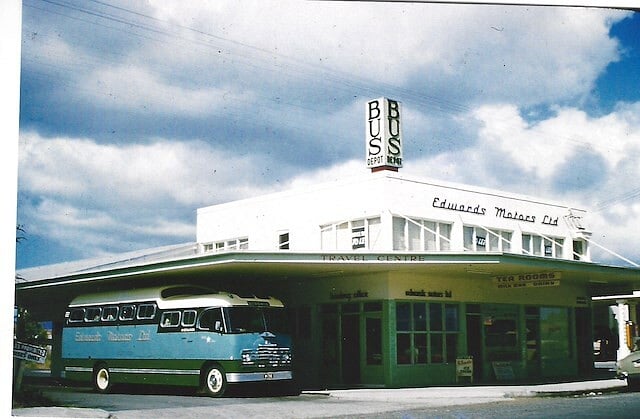
Charlie fought the government-owned Railways Road Services and Hamilton's Buses Ltd in licensing hearing after hearing. He never took a subsidy. When the Matamata council refused him a sealed loading area or shelter, he built his own terminal on Broadway.
The Vistaliner years and the end
In 1956 Edwards introduced Bedford SB "Vistaliners" with radios, heaters, an on-board toilet, and hostesses serving tea and biscuits. Edwards also took over Auckland sightseeing tours, ran tourist work to Rotorua and the Chateau, and was even involved in the fledgling airline SPANZ. In 1969 Charlie sold the business to Keith Laugesen of Midland Motors, ending 41 years of Edwards Motors.
In their own words
"The point about it is this..."
Every story in the book eventually comes back to Charlie. He was strict, teetotal in business, and obsessed with timetables, engine revs and clean paintwork. Jean Strathdee, the office junior, remembered him correcting any driver who greeted her as "Jean" with "Miss Strathdee, please."
He also won every argument. When a horse jumped off a bank at Te Hoe and hit Jim Webb's Diamond T, Charlie studied the trip recorder and found Jim was five minutes late. "If you'd have been on time the horse would have been somewhere else, the bus would have been somewhere else and the accident wouldn't have happened. The point is this: keep to the timetable!" Ron Charles got the same treatment after a drunk driver scraped his bus near Matamata. Charlie pointed to a two-minute stop at Te Poi as the real cause.
Yet the stories show a softer side too. One hot Christmas Eve the garage staff slipped across to the Strand Hotel for a drink. Moments later Charlie pulled up in his green Austin Seven with ice creams for everyone. Jean rang the pub, and the men filed back across the road with sheepish grins. Bill Shears once let a mother's two young boys ride free on a packed bus, only for Charlie to board, inspect tickets, and end up with both boys on his lap. "Keep up the good work!" he said as he got off. For years afterwards he greeted Bill by asking when he'd pay back the six shillings.
Mrs Monty and the people behind the scenes
Anona Montgomery ran the head office for 27 years. Staff agree she kept many an error from reaching Charlie and his "cool wrath". She hosted parties at her Onehunga home where drivers, mechanics and office staff from every branch got to know each other. Those gatherings built the friendships that still filled reunions decades later.
Maurie Evershed, the traffic manager, was the peacemaker. Bruce Perris was sacked three times: once for filling a bus with timber he'd found on the road, once for bringing back Christmas trees, and once for loading two "dead" sheep that came back to life in the Parnell garage. Each time, Maurie quietly got him reinstated. The sheep knocked garage supervisor Gordon Harrop into the inspection pit and escaped up Stanley Street towards the Domain. They were never seen again.
In the Matamata office, Ann Toomey wrote waybills, sold tickets, phoned businesses to collect their parcels, and handled day-old chicks, cinema films and a mysterious "bull box" from the local vet. All this, plus cleaning, for about two pounds ten a week.
Life on the road
Drivers did far more than drive. They threw rolled-up newspapers to farm gates, delivered mail, ran errands for farmers, and released a pigeon fancier's birds at the Kaimai summit for a shilling. A farmer once complained to Digger Tibby that he hadn't sounded the horn that morning. Drivers had tooted at his cowshed for a decade, and it was his signal to get the cream out before the cream truck came.
The night "Herald runs" carried the morning paper south through fog, peat smoke and wandering cattle. John Taylor's account of one night to Taupo includes nudging another bus in the fog, a ute stuck on top of a barberry hedge, a roadside garage owner changing his spark plugs at 3am, and a hitchhiker leaping out of a newspaper box at Kinleith.
Humphrey Beale's "funniest accident" is a highlight. A home-built Packard caravan tipped over in front of his coach just after petrol rationing ended. Out came children, cats, flour and strawberry jam, then a furious Mum who bit Dad and slapped Humphrey. His passengers laughed all the way to Morrinsville.
Hostesses, tea and too much shortbread
The Vistaliners brought on-board hostesses in light blue air-force-style uniforms. Ann Stokes remembered serving tea in lidded cardboard cups ("it tasted a bit like cardboard too") and endless Kohi shortbread. After she married, it was ten years before she could face buying shortbread again. The toilet had its moments too, including the day Charlie proudly opened its little trapdoor for visiting dignitaries just as a hostess was using it.
Love found a way
Charlie banned fraternising between staff, even single ones. "Nevertheless love found a way." Tui McLaren married Sam Armstrong, Jean Strathdee married Jim Webb, Bill Winchester married Marj Crighton, and Betty Tilsley married Humphrey Beale. When Laurie Stokes and Ann Toomey married in 1962, Ann had to leave the company. The two of them went on to become the mainstays of the reunions, and the compilers of this book
"We work for Charlie Edwards"
Much of the Edwards world has gone. The Parnell head office on Gittos Street is now an empty section, and even the street name has disappeared. The Matamata terminal Charlie built still stands on Broadway, though a hairdresser now occupies the old loading platform. The Reo Pushers ended their days as a camper, a caravan office and a racecourse judges' box.
What survived was the bond between the people. Digger Tibby summed Charlie up as a man of vision: the first operator to fit heaters and radios and to put hostesses on long-distance services. He also built a team who were "proud to say 'We work for Charlie Edwards.'" Thirty years after the company closed, Humphrey Beale noted that the old staff (and widows) still met every year at Matamata. These days someone checks his watch around four and says he'd like to be off the road before dark. "Before dark??? We used to race through the fog and dark and peat smoke at 60 miles per hour... taking the Heralds to Rotorua!"